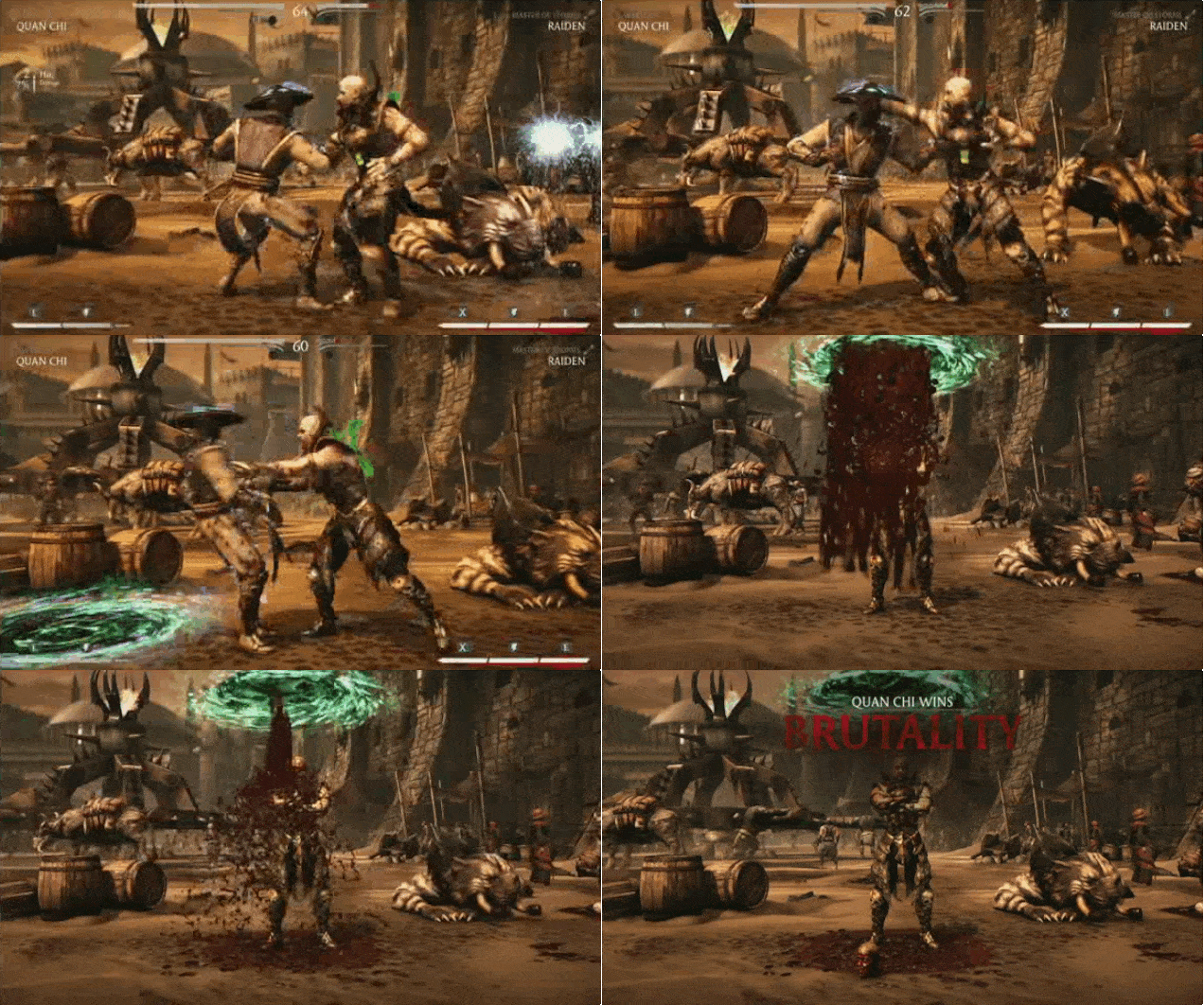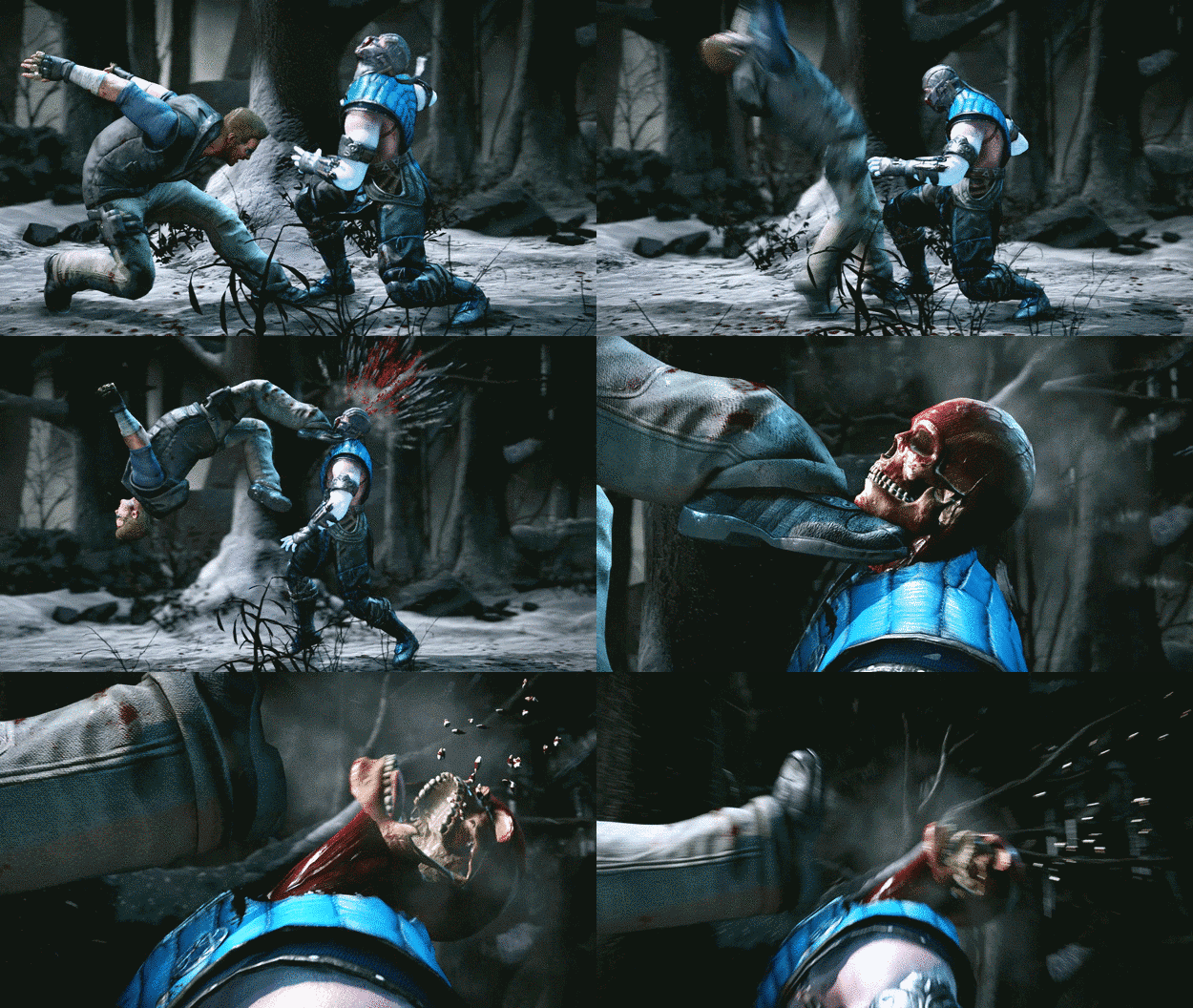
Legacy & Cultural Impact-
Ed Boon reported that the Mortal Kombat games have sold 26 million copies by 2007, and the number has reportedly reached over 30 million by 2012. As of April 2015, after the release ofMortal Kombat X, the franchise had sold 35 million units. A particularly successful game was Mortal Kombat II, which had unprecedented opening week sales figures never seen before in the video game industry, for the first time beating the box office numbers of summer hit films.The 2008 edition of Guinness World Records Gamer's Edition awarded the Mortal Kombatseries with seven world records, including "most successful fighting game series". The franchise holds ten world records in the 2011Guinness World Records Gamer's Edition, including the "largest promotional campaign for a fighting video game" (Mortal Kombat 3), "highest grossing film based on a beat ‘em up video game" (Mortal Kombat 1996), and "most successful video game spin-off soundtrack album" (Mortal Kombat: Original Motion Picture Soundtrack).
Numerous publications described it as one of the most important and also most violent series in the history of video games; in 2011, the staff ofGameSpy wrote "its place in fighting game history is undeniable." In 2009, GameTrailers rankedMortal Kombat as the ninth top fighting game franchise as well as the seventh bloodiest series of all time. In 2012, Complex rankedMortal Kombat as 37th best video game franchise overall, commenting on its "legendary status in video game history." Mortal Kombat as a series was also ranked as the goriest video game ever by CraveOnline in 2009 and by G4tv.com in 2011; including it on their list of the goriest games, Cheat Code Central commented that "Mortal Kombat had enough gore to simultaneously offend a nation and change gaming forever."
According to IGN, during the 1990s "waves of imitators began to flood the market, filling arcades with a sea of blood from games like Time Killers,Survival Arts, and Guardians of the Hood. Mortal Kombat had ushered in an era of exploitation games, both on consoles and in arcades, all engaging in a battle to see who can cram the most blood and guts onto a low-res screen." Notable Mortal Kombat clones, featuring violent finishing moves and/or digitized sprites, included Bio F.R.E.A.K.S., BloodStorm, Cardinal Syn, Catfight, Eternal Champions, Kasumi Ninja,Killer Instinct, Mace: The Dark Age, Primal Rage, Street Fighter: The Movie, Tattoo Assassins, Thrill Kill, Ultra Vortek, Way of the Warrior, and Midway's own War Gods, among many others (even the Japanese game Tsuukai Gangan Kohshinkyoku was localized in the U.S. as Aggressors of Dark Kombat). Of all these, only Eternal Champions and Killer Instinct achieved a considerable success and were followed by sequels (Eternal Champions: Challenge from the Dark Sideand Killer Instinct 2).
In a 2009 poll by GamePro, 21% of voters chose Mortal Kombat as their favorite fighting game series, ranking it third afterStreet Fighter and Tekken. In 2012, Capcom's Street Fighter producer Yoshinori Ono said he is getting a lot of requests for Street Fighter vs. Mortal Kombat and understands why people want it, "but it's easier said than done. Having Chun Ligetting her spine ripped out, or Ryu's head bouncing off the floor...it doesn't necessarily match." In 2014, martial artistFrankie Edgar opined Mortal Kombat has been far superior to Street Fighter.
The series and its characters are also referenced in the various other works of popular culture, such as in the title ofPowerglove's debut album Metal Kombat for the Mortal Man and the Workaholics episode "Model Kombat". According toComplex in 2012, "Years ago, MK became a phenomenon far outside gaming circles alone. Its name has become recognizable enough to be name dropped on sitcoms (Malcolm in the Middle and Married... With Children), found in movies (Christian Slater plays MK4 in Very Bad Things), and used as part of cultural studies (see Justine Cassell and Henry Jenkins' book From Barbie to Mortal Kombat: Gender and Computer Games)." It was also featured on Gregg Araki's filmDoom Generation and on Larry Clark's Bully.
The name "Mortal Kombat" was even given to a dangerous illegal recreational drug that was introduced and caused multiple fatalities in early 2014.
In 2012, John Tobias said: "If you look at any other pop culture phenomenon—like if you look at the Teenage Mutant Ninja Turtles, for instance—it became popular at the time right around when Mortal Kombat became popular, and it had its highs and lows, and here they are once again talking about a major motion picture. That’s because of its place in pop culture. It’s always there for someone to pick up, polish off, blow the dust off of it, and re-release it. And Mortal Kombat will always be that way. It’ll be around 50 years from now.
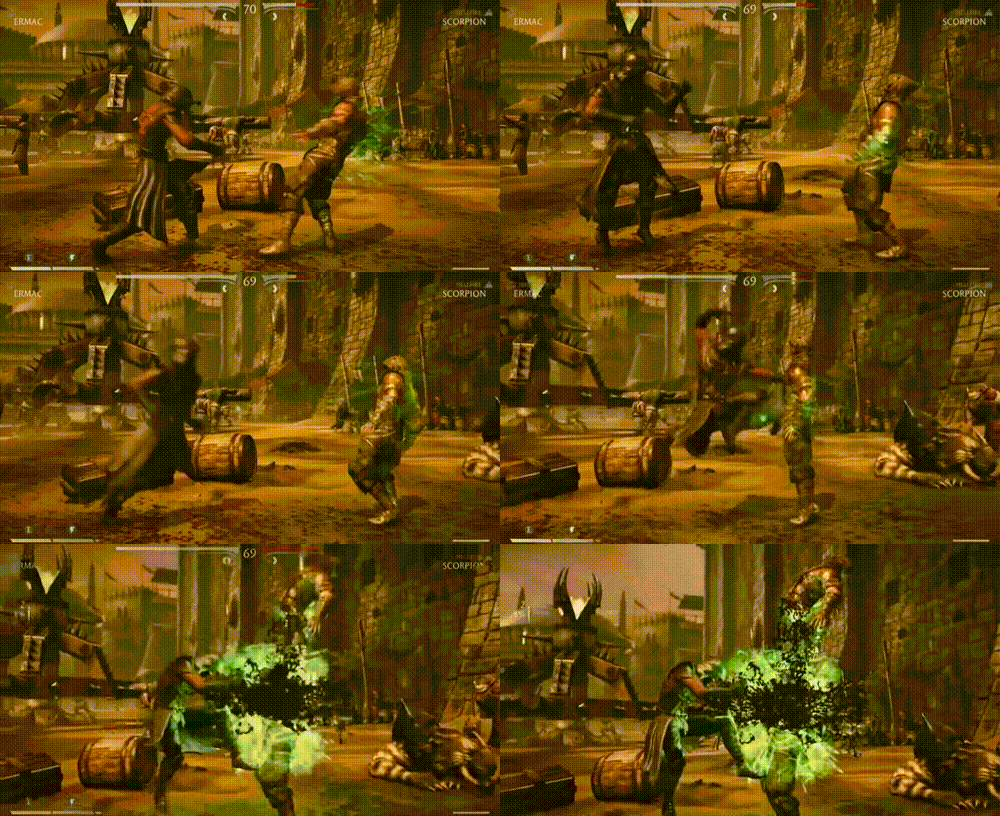
Fighting Games-
The original Mortal Kombat game was released for arcade machines during October 1992, having since been ported to several console and home computer systems by Probe Software and released by Acclaim Entertainment. The sequel,Mortal Kombat II, was released for arcades in 1993, featuring an increased roster and improved graphics and gameplay, then ported to the numerous home systems in 1993-1995 by Probe Entertainment and Sculptured Software, released again by Acclaim; it was rereleased in 2007 for the PlayStation 3. Mortal Kombat 3 followed in 1995 in both arcade and home versions. MK3 got two updates which expanded the number of characters and other features from the game: Ultimate Mortal Kombat 3, published that same year, and Mortal Kombat Trilogy the next year. The following game, Mortal Kombat 4, was released in 1997, marked the jump of the series to 3D rendered graphics instead of the series' previously staple digitized 2D graphics. Mortal Kombat 4 was ported to the PlayStation, Nintendo 64 and PC. An update of MK4 titledMortal Kombat Gold was released exclusively for the Dreamcast in 1999.
While to this point Mortal Kombat games were only titled with their installment number, starting with Mortal Kombat: Deadly Alliance in 2002, the series' naming scheme changed to favor the use of sub-titles instead. It was also at this point that the series started being targeted at consoles only, with Mortal Kombat 4 being the last game in the series to ever be released for the arcades. Deadly Alliance was released initially for the Xbox, PlayStation 2 (PS2) and GameCube.Deadly Alliance was also the first Mortal Kombat game to feature fully 3D gameplay, where up to Mortal Kombat 4 the gameplay had stayed in a 2D plane; this trend would continue for the following two games. The Game Boy Advance port titled Mortal Kombat: Tournament Edition was released in 2003. The next sequel was the 2004 Mortal Kombat: Deception, released for the PS2, Xbox and GameCube. Its port for the PlayStation Portable, Mortal Kombat: Unchained, was developed by Just Games Interactive in 2006. Mortal Kombat: Armageddon was published in the same year for the PS2, Xbox, and in 2007 on the Wii. In 2008, Midway released the Mortal Kombat Kollection, an anthology of the three then-most recent titles to the main franchise: Mortal Kombat: Deception, Mortal Kombat: Shaolin Monks, and Mortal Kombat: Armageddon. Mortal Kombat vs. DC Universe, a crossover between the Mortal Kombatfranchise and DC Universe released in 2008 for the PlayStation 3 and Xbox 360.
A ninth game in the series, a reboot titled simply Mortal Kombat, was developed by former Midway Games Chicago, now owned by Warner Bros. Games and renamed as NetherRealm Studios. It was first released for the PlayStation 3 and Xbox 360 in 2011, and was ported for the PlayStation Vita in 2012 and for the PC Windows in 2013. A sequel, Mortal Kombat Xwas released in April 2015 on PlayStation 4, Xbox One, and Microsoft Windows.
Development History-
Mortal Kombat started development in 1991 with only four people: Ed Boon, John Tobias, John Vogel and Dan Forden. In 2009, Boon said: "The first Mortal Kombat game was 4 guys, literally, one programmer, myself (Boon), two graphics guys (Tobias and Vogel), and a sound guy (Forden) was the entire team, literally." Originally, Boon and Tobias were approached to create a video game adaptation of the 1992 film Universal Soldier starring martial arts film actor Jean-Claude Van Damme, with a digitized version of the action star fighting villains. Intending to make a game "a lot more hard edge, a little bit more serious, a little bit more like Enter the Dragon or Bloodsport" than Street Fighter II silly cartoon fantasy style, Boon and Tobias decided to continue their project even after the deal to use the Bloodsport license fell through.One of their own characters, Johnny Cage, became "a spoof on the whole Van Damme situation."
John Tobias said that his inspirations for the game's story and characters came from the Chinese mythology and some of the stories and rumored events about the Shaolin monks. Regarding the film Big Trouble in Little China, Tobias wrote that although this movie "kind of Americanized my obsession for supernaturalkung fu films from China, it was not my biggest influence. My biggest influences came from Tsui Hark films -- Zu Warriors & The Swordsman. We had to get them from bootleggers in Chicago's Chinatown." Tobias' writing and artistic input on the series ended in 1997. Fifteen years later, he said: "I knew exactly what I was going to do with a future story. A few years ago I [wrote] a sort of sequel to the first MK film and an advancement to the game's mythological roots. The goal was to not runaway from what came before with a retelling, but to move the themes forward. I did it for fun as an exercise in screenwriting, but it felt good to get that out of my system."
Ed Boon recalled that for six out of the eight months while they were in production of the original Mortal Kombat, "nobody could come up with a name nobody didn't hate." Some of the names suggested included "Kumite", "Dragon Attack", "Death Blow" and just "Fatality". Someone had written down "combat" on the drawing board for the names in Boon's office and then someone wrote a K over the C, according to Boon, "just to be kind of weird." Steve Ritchie, a pinball designer at that time, was sitting in Boon's office and saw the word "Kombat" and said to Boon, 'Why don't you name it Mortal Kombat?' and that name "just stuck." Since then, the series uses the letter "K" in place of "C" for various words containing the hard C sound. According to Boon, during the MK games' development they usually spell the words correctly and only "korrect it" when one of the developers points out they should do it.
Graphics-
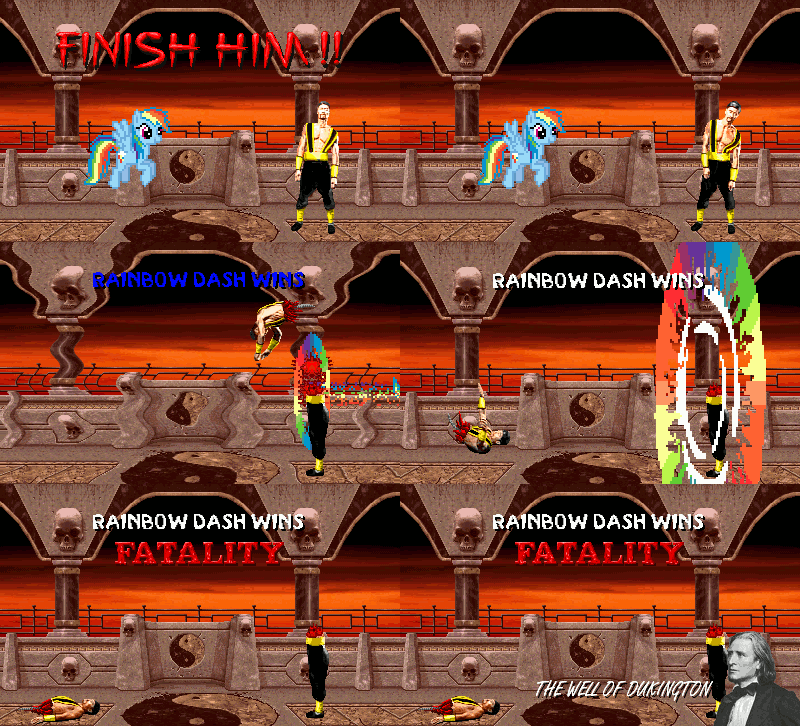
The characters of the original Mortal Kombat and its initial sequels were created using digitized sprites mostly based on filmed actors, as opposed to drawn graphics. Early Mortal Kombat games were known for their extensive use ofpalette swap, a practice of re-coloring certain sprites to appear as different characters which was used for the ninja characters. In fact, many of the most popular characters have originated as simple palette swaps. In the very first game, the male ninja fighters were essentially the same character; only the colors of their attire, fighting stance, and special techniques indicated the difference. Later games added other ninjas based on the same model, as well as several female ninja color swap characters initially also using just one base model (beginning with Kitana in Mortal Kombat II). All of them gradually became very different characters in the following installments of the series.
Mortal Kombat 4 brought the series into 3D, replacing the digitized fighters of previous games with polygon models. The team switched from digitized actors to motion capture technology.
Mortal Kombat included secret characters, secret games, and other Easter eggs. For example, Mortal Kombat 3 includes a hidden game of Galaga and there is a hidden game of Pong in Mortal Kombat II. Many extras in the series have only been accessible through very challenging, demanding, and sometimes coincidental requirements. The Sega Mega Drive/Genesis versions contains some unique eggs, such as "Fergality". The Sega Mega-CD version also contained an additional code (known as the "Dad's Code"), which changed the names of the fighters to that of characters from the classic comedy series Dad's Army. Popular characters of Reptile and Jade were originally introduced as hidden enemies, becoming playable after returning in subsequent games.
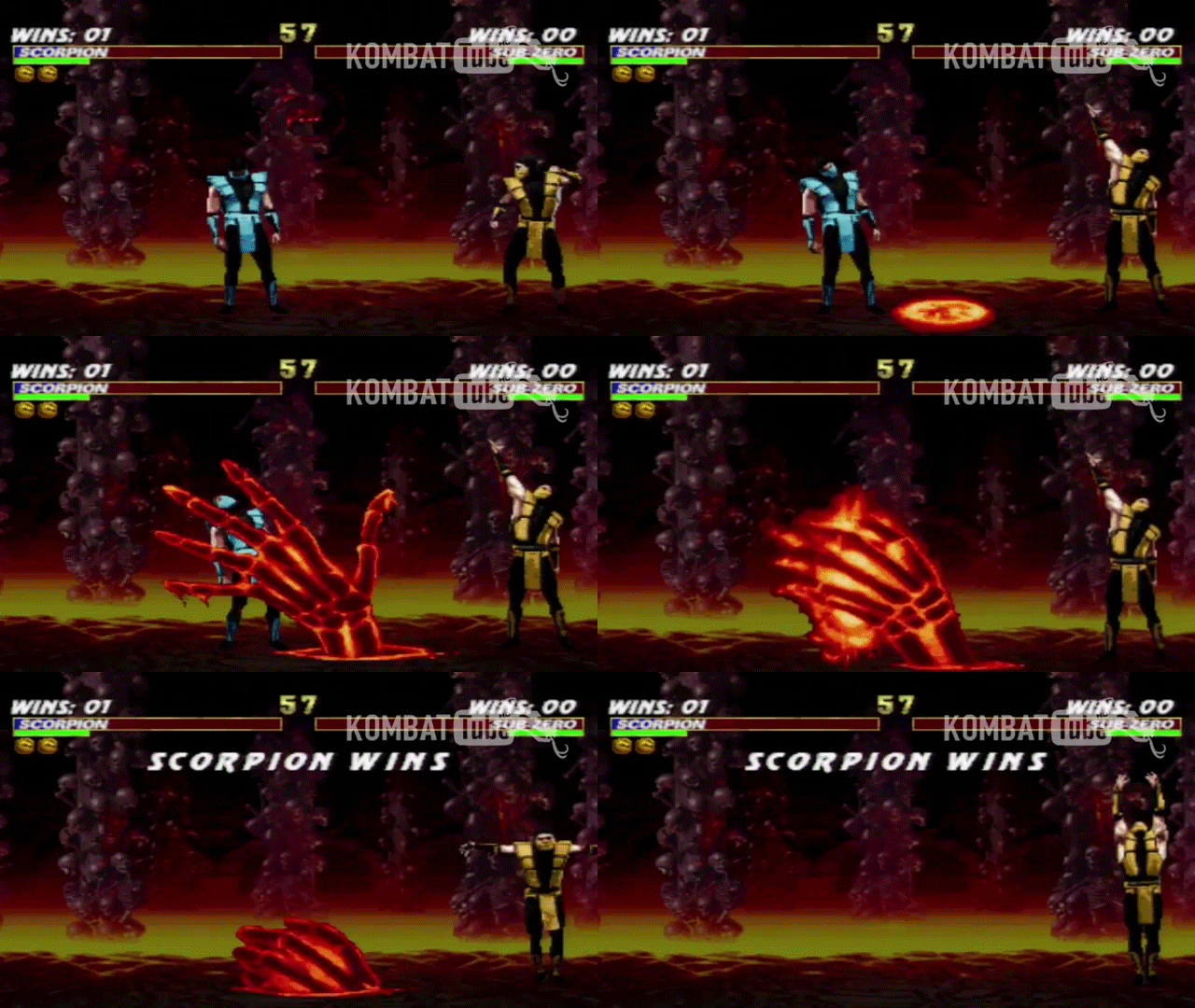
Some Easter eggs originated from in-jokes between members of the development team. One example is "Toasty", which found its way into the game in the form of a small image of sound designer Dan Forden, who would appear in the corner of the screen during gameplay (after performing an uppercut) and yell the phrase "Toasty!" This egg was also the key to unlocking the hidden character Smoke when it happened in the Portal stage. In Mortal Kombat 4, Forden would say "Toasty! 3D!" after Scorpion did his burn Fatality, a reference to the fact that it is the first 3D game of the series."Toasty!" is also found in Mortal Kombat: Shaolin Monks, appearing randomly after the character pulls off a chain of hits, though the picture of Forden was removed for that title, but brought back for the 2011 Mortal Kombat game.
Yet another private joke was the hidden character Noob Saibot, who has appeared in various versions of the game starting with Mortal Kombat II. The character's name derived from two of the series' creators' surnames, Ed Boon and John Tobias, spelled backwards. In addition, a counter for ERMACS on the game's audits screen (ERMACS being short for errormacros), was generally considered by some players to be a reference to a hidden character. The development team decided to turn the rumor into reality, introducing Ermac in Ultimate Mortal Kombat 3 as an unlockable secret character. The character Mokap, introduced in Mortal Kombat: Deadly Alliance, is a tribute to Carlos Pesina, who played Raiden in MK and MKII and has served as a motion capture actor for subsequent titles in the series.
Plot-
The series takes place in a fictional universe consisting of eighteen surviving realms which, according to in-game backstories, were created by the Elder Gods. The Mortal Kombat: Deception manual described six of the realms as: "Earthrealm, home to such legendary heroes as Liu Kang, Kung Lao, Sonya Blade, Johnny Cage, and Jax, and also under the protection of the Thunder God Raiden; Netherrealm, the fiery depths of which are inhospitable to all but the most vile, a realm of demons and shadowy warriors such as Quan Chi and Noob Saibot; Outworld, a realm of constant strife which Emperor Shao Kahn claims as his own; Seido, The Realm of Order, whose inhabitants prize structure and order above all else; The Realm of Chaos, whose inhabitants do not abide by any rules whatsoever, and where constant turmoil and change are worshipped; and Edenia, which is known for its beauty, artistic expression, and the longevity of its inhabitants." The Elder Gods decreed that the denizens of one realm could only conquer another realm by defeating the defending realm's greatest warriors in ten consecutive Mortal Kombat tournaments.
The first Mortal Kombat game takes place in Earthrealm (Earth) where seven different warriors with their own reasons for entering participated in the tournament with the eventual prize being the continued freedom of their realm, threatened with a takeover by Outworld. Among the established warriors were Liu Kang, Johnny Cage and Sonya Blade. With the help of the Thunder God Raiden, the Earthrealm warriors were victorious and Liu Kang became the new champion of Mortal Kombat.In Mortal Kombat II, unable to deal with his minion Shang Tsung's failure, Outworld Emperor Shao Kahn lures the Earthrealm warriors to the Outworld where the Earthrealm warriors eventually defeat Shao Kahn. By the time of Mortal Kombat 3, Shao Kahn revives Edenia's (now a part of his Outworld domain) former queen Sindel in Earthrealm, combining it with Outworld as well. He then attempts to invade Earthrealm but is ultimately defeated by the Earthrealm warriors again. After Kahn's defeat, Edenia was freed from Kahn's grasp and returned to a peaceful realm, ruled by Princess Kitana. The following game, Mortal Kombat 4, features the former elder god Shinnok attempting to conquer the realms and attempting to kill the thunder god Raiden. However, he is also defeated by the Earthrealm warriors.
In Mortal Kombat: Deadly Alliance, the evil sorcerers Quan Chi and Shang Tsung join forces to conquer the realms. ByMortal Kombat: Deception, after several fights, the sorcerers emerge victorious having killed most of Earthrealms' warriors until Raiden steps forth to oppose them. The Dragon King Onaga, who had been freed by Reptile at the end of Mortal Kombat: Deadly Alliance, had deceived Shujinko into searching for six pieces of Kamidogu, the source of Onaga's power. Onaga then confronted the alliance of Raiden, Shang Tsung, and Quan Chi and thus obtained Quan Chi's amulet, the final piece of his power. Only a few warriors remained to combat against the Dragon King and his forces. Shujinko eventually triumphed over the Dragon King and removed his threat to the Mortal Kombat universe.
In Mortal Kombat: Armageddon the catastrophe known as Armageddon starts. Centuries before the first Mortal Kombat, Queen Delia foretold the realms would be destroyed because the power of all warriors from all the realms would rise to such greatness it would overwhelm and destabilize the realms, triggering an all-destructive chain of events. King Argus had his sons, Taven, and Daegon, put into incubation who would one day be awakened to save the realms from Armageddon by defeating a firespawn known as Blaze. In the end, however, Shao Kahn is the one who defeats Blaze, causing Armageddon.
In Mortal Kombat (2011), it is revealed that the battle between the warriors of the six realms culminated into only two survivors: Shao Kahn and Raiden. Badly beaten, Raiden had only one last move he could make to prevent Shao Kahn from claiming the power of Blaze. He sends last-ditch visions of the entire course of the Mortal Kombat timeline to himself in the past right before the tenth Mortal Kombat tournament (first game). This transfer of information to his former self causes a rift in time, causing a new "reboot" timeline to be introduced that splits off from the original Armageddon timeline, with a new outcome of Mortal Kombat history to be written. But this story leads to even worse unforeseen events. It ends with many of the main game characters dying at the hands of Queen Sindel and Raiden accidentally killing Liu Kang in self-defense. Eventually, the Elder Gods aid Raiden in killing Shao Kahn and saving Earthrealm. But as the scene goes on it is later revealed that this was all a plan by Lord Shinnok and Quan Chi.
Mortal Kombat X sees Shinnok and Quan Chi enacting their plan, leading an army of undead revenants of those that were killed in Shao Kahn's invasion against the realms. A team of warriors led by Raiden, Johnny Cage, and Sonya Blade oppose Shinnok, and in the ensuing battle, Shinnok is imprisoned, Quan Chi escapes, and various warriors are resurrected and freed from Shinnok's thrall. Twenty-five years later, Quan Chi resurfaces and allies himself with the insect-like D'Vorah in manipulating events that lead to Shinnok's release. Though Quan Chi is killed by a vengeful Scorpion in the process, Shinnok resumes his assault against the realms. After a grueling, protracted battle, Shinnok is defeated by Cassandra Cage representing the next generation of Earthrealm's warriors. With both Quan Chi and Shinnok gone, the undead revenants of Liu Kang and Kitana assume control of the Netherrealm and Lord Raiden now protects the Earthrealm not defensively but offensively with the help of the remaining revenants.
Gameplay-
The original three games and their updates, Mortal Kombat, Mortal Kombat II,Mortal Kombat 3, Ultimate Mortal Kombat 3 and Mortal Kombat Trilogy, were styled in a 2D fighting fashion. The first two of them were played in the arcades with ajoystick and five buttons: high punch, low punch, high kick, low kick, and block.Mortal Kombat 3 and its updates added a sixth "run" button. Characters in the early Mortal Kombat games play virtually identically to one another, with the only major differences being their special moves. Through the 1990s, the developer and publisher Midway Games would keep their single styled fighting moves with four attack buttons for a different array of punches and kicks and blocks. Mortal Kombat: Deadly Alliance changed this by differentiating characters normal moves and even giving them multiple fighting styles. Beginning in Deadly Alliance and until Mortal Kombat: Deception, the characters would have three fighting styles per character: two unarmed styles, and one weapon style. Few exceptions to this arose in Mortal Kombat: Armageddon, such as monster-like boss characters like Moloch and Onagawho would have only one fighting style. While most of the styles used in the series are based on real martial arts, some are entirely fictitious. Goro's fighting styles, for example, are designed to take advantage of the fact that he has four arms. For Armageddon, fighting styles were reduced to a maximum of two per character (generally one hand-to-hand combat style and one weapon style) due to the sheer number of playable characters. Mortal Kombat vs. DC Universe dropped the multiple fighting style trend altogether in favor of giving each character a much wider variety of special moves, but some characters still use multiple fighting styles. 2011's Mortal Kombat returned to a single 2D fighting plane although characters are rendered in 3D; unlike previous MK games, each of four buttons on the game controller represents an attack linked to a corresponding limb.
According to Mortal Kombat co-creator Ed Boon, "since the beginning, one of the things that's separated us from other fighting games is the crazy moves we've put in it, like fireballs and all the magic moves, so to speak." When asked ifCapcom's Street Fighter series would ever do a crossover game with Mortal Kombat, Street Fighter producer Yoshinori Onocalled Mortal Kombat a very different serious game from Street Fighter fun silly fantasy style. Capcom's senior director of communications compared Street Fighter and Mortal Kombat by asking if the interviewer preferred the "precision and depth" of Street Fighter or the "gore and comedy" of Mortal Kombat; he also stated that the Street Fighter and Mortal Kombat rivalry was considered similar to the Coke and Pepsi rivalry in the 1990s. Senior producer of Mortal Kombat vs. DC Universe, Hans Lo, himself also called Street Fighter "a little more cartoonic fantasy" in comparison to Mortal Kombat.In 2013, Boon named the hypothetical "MKvsSF" as his dream crossover game. In 2014, Boon said his team has remained in touch with Capcom, but no one could resolve the incompatibility problem of Mortal Kombat being much more brutal than Street Fighter.
Mortal Kombat: Deception and Mortal Kombat: Armageddon feature "Konquest", a free-roaming action-adventure mode that significantly expanded on the single-player experience. Both games also include distinct minigame modes such "Chess Kombat", an action-strategy game similar to Archon. Two other bonus minigames, "Puzzle Kombat" inspired by Puzzle Fighter and "Motor Kombat" inspired by Mario Kart, feature super deformed versions of Mortal Kombat characters. The games also contain various unlockable content and hidden "cheats".